 |
|
|
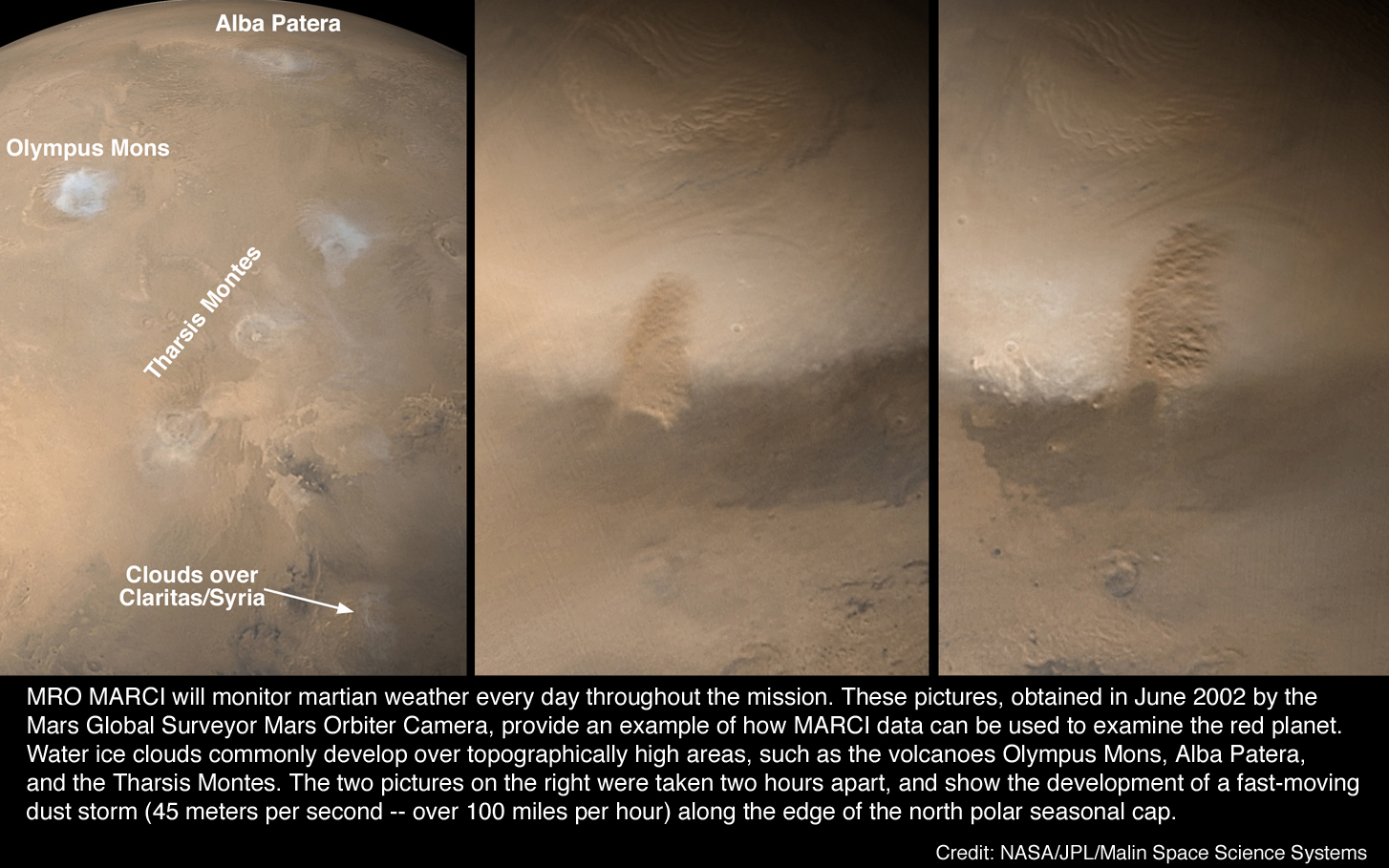
The Mars Color Imager (MARCI) is designed to acquire daily global images of Mars for at least 1 martian year at 5 visible wavelengths and 2 ultraviolet wavelengths. MARCI will recover the objectives of the Mars Climate Orbiter MARCI wide angle camera, which was lost during orbit insertion in September 1999. MARCI is critical to extending and enhancing the record of continuous daily weather observations that began in April 1999 with the Mars Global Surveyor (MGS) Mars Orbiter Camera (MOC).
The MARCI Science Objectives are to:
Atmospheric Science:
MARCI will observe the distribution of dust, condensates (water and carbon dioxide clouds), and ozone in the martian atmosphere. Cloud structure and their relation to topography and circulation patterns predicted by global circulation computer models will be examined, as will the general relationship of meteorology to local topographic features. The key studies for MARCI center on daily monitoring of dust storms, polar cloud formation, and variations in ozone content of the atmosphere.
Surface/Atmosphere Interaction:
The martian atmosphere interacts with the planet's surface in two ways: frost can form and sublime away, and wind can blow and move dust around. MARCI images will be used to monitor the locations in which dust storms occur, as these indicate areas where there is sufficient loose dust to be blown by the wind. MARCI images will also show how the brightness and color of the surface varies from place to place over the course of a martian year, which gives some indication of where dust is eroded from, and deposited by, dust storms and dust devils. Finally, MARCI will also monitor the seasonal growth and retreat of the water ice and carbon dioxide ice in the polar regions, and its color spectra will be used to obtain compositional information about iron-bearing materials on the planet.