Mars Science Laboratory (MSL)
Mast Cameras (Mastcam)
Science Objectives
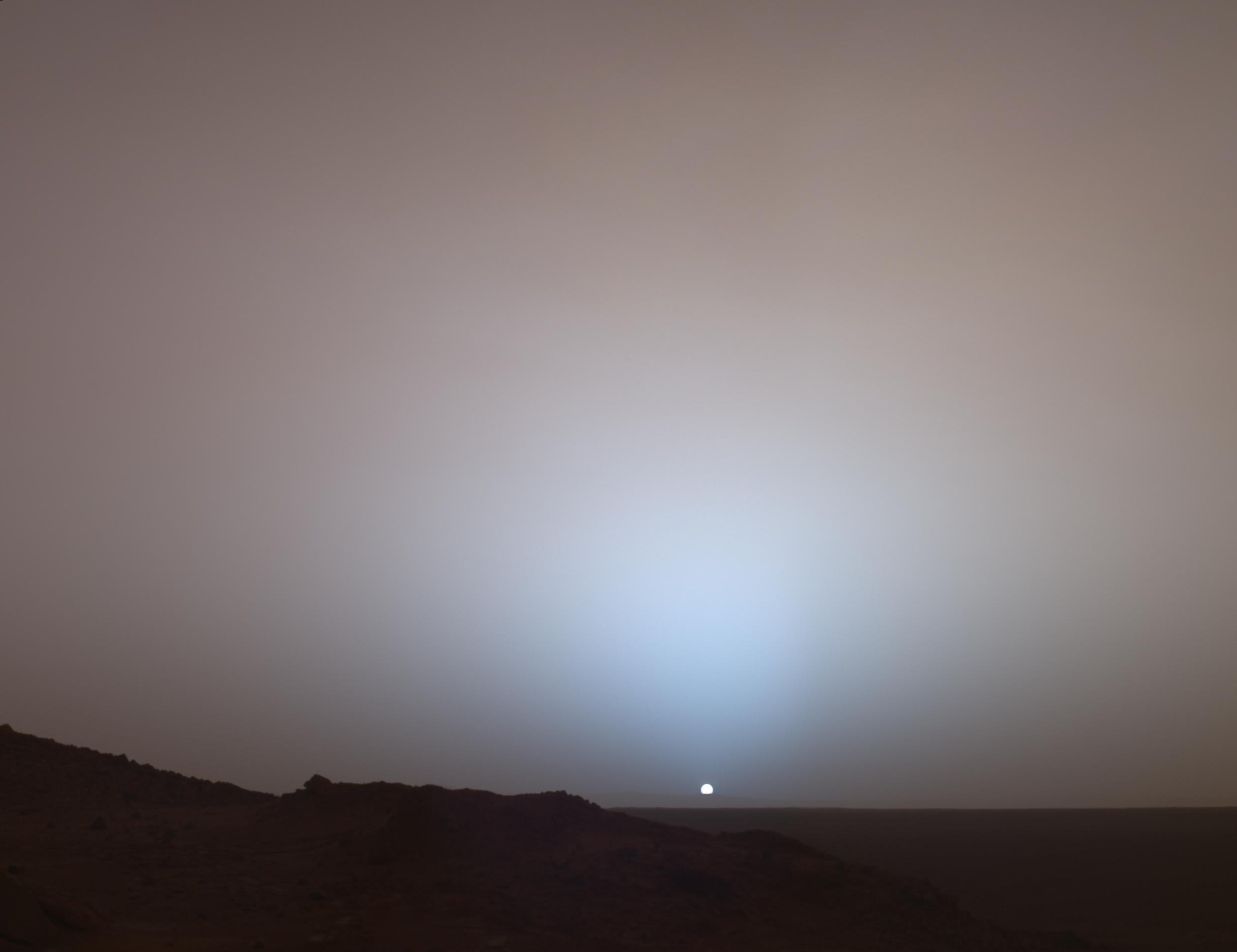
Sunset over Gusev Crater, captured 19 May 2005, by the Pancam
system on the Spirit rover. Like Pancam, the MSL Mastcam
system will acquire multispectral color views of geologic
and atmospheric features. Mastcam also provides both natural
color still and high definition video capability.
-- Image Credit: NASA/JPL/Texas A&M/Cornell
Main Objective: To contribute to the characterization and help
determine the details of the history and processes recorded in geologic
material at the MSL site on Mars.
Science Goals:
Observe landscape physiography and processes at the MSL site.
Mastcam images will be used to determine local topography,
geomorphology, and the geologic setting of the MSL site. This
contributes to understanding the nature of both past and present
geologic processes at the site.
Examine rocks at the MSL site. Mastcam images will be
used to examine and contribute to studies of the texture, morphology,
structure, mineralogy, stratigraphy, history, and alteration of
rocks encountered by the MSL rover.
Examine fines at the MSL site. “Fines” is a term that
describes all of the sand, silt, and dust on Mars. Mastcam data
will be used to study the fines in the martian regolith (the dirt),
including their physical and mechanical properties, the results
of rover hardware interaction with the fines, plus the stratigraphy,
texture, mineralogy, and depositional processes involved.
Observe frost and ice at the MSL site. Images from
the Viking 2 lander and the rover, Opportunity, showed frost on Mars
at middle and equatorial latitudes, respectively. If frost or ice
are present at the MSL site, and visible during the day, then Mastcam
data will be used to help characterize the texture, morphology,
thickness, stratigraphic position, and relation to the regolith of
these materials. In addition, if they are present, Mastcam images
will be used to examine ice-related geomorphic features, such
as patterned ground landforms (e.g., polygons).
Document atmospheric and meteorologic events and processes.
Mastcam will be used to observe clouds, dust-raising events (dust storms, gusts,
and dust devils), the properties of suspended aerosols (dust and
ice crystals high in the atmosphere), and, using its video capability,
the transport of fines by wind.
Facilitate other MSL science. Mastcam data will be
used to help the MSL science teams decide where to collect samples,
where to drive the rover to next, and to help characterize the nature
of the materials the other instruments will examine.